
Image: Fitzroy JFC designed by Emma Bamblett
To celebrate the 2025 Sir Doug Nicholls Round, AFL Victoria put a call out for local clubs across the state to submit their 2025 Indigenous Round guernsey designs, with the most popular design to be voted by the community.
Visit the AFL Victoria Instagram and Facebook pages to vote for you favourite design.
Held across Rounds 10 and 11 in 2025, this season marks the 10th year the league celebrated the occasion in honour of Pastor Sir Doug Nicholls, and the 19th year the AFL has held a dedicated Indigenous round.
The milestone also coincided with the 20th anniversary of the Indigenous Team of the Century and the 30th milestone of the establishment of the Peek Rule (formally known as Rule 30) that marked a significant step in combating racism in Australian sport.
Continue reading below to learn about eight of the eight finalist designs.
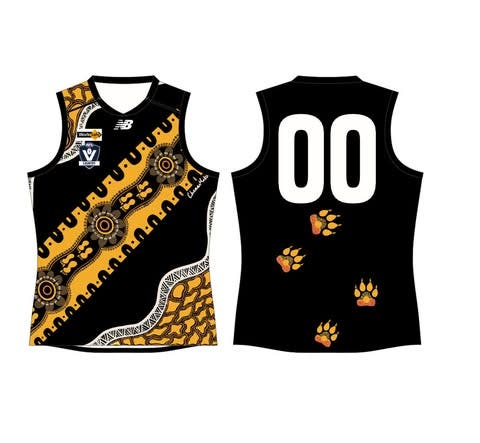
Red Cliffs FNC - Sunraysia FNL
Artist: Chantelle Mitchell
Each gathering circles represents the various teams involved with the Red Cliffs Football Club, including men’s footy teams, women’s netball teams, and junior’s footy/netball teams, as well as the members, supporters and volunteers. The footprints symbolize the strong connection the club has with the community and everyone who has been involved for many years, showing that the club is not just about sports but also about building relationships and strong connections. The black symbols Honor current and past First Nations players who have contributed to the club, recognizing their vital role in its history and culture. The tiger paw prints represent the strength and resilience of the players, as well as the diverse tribes in the local area, highlighting the unity and pride that comes from being part of such a great community. This connection fosters a sense of belonging and encourages future generations to engage with the club.
The Indigenous round this year will be a collaboration and celebration of our local culture, Indigenous players and their beautiful families- some are new to our club this year. Local Artist Chantelle Mitchell has collaborated with the club and designed an awesome game day jersey for both football and netball with support from the AFL Telstra footy grants. We will have local Indigenous Members at the club to help celebrate the day. Our local Aboriginal service will also be there with fun activities for the kids.
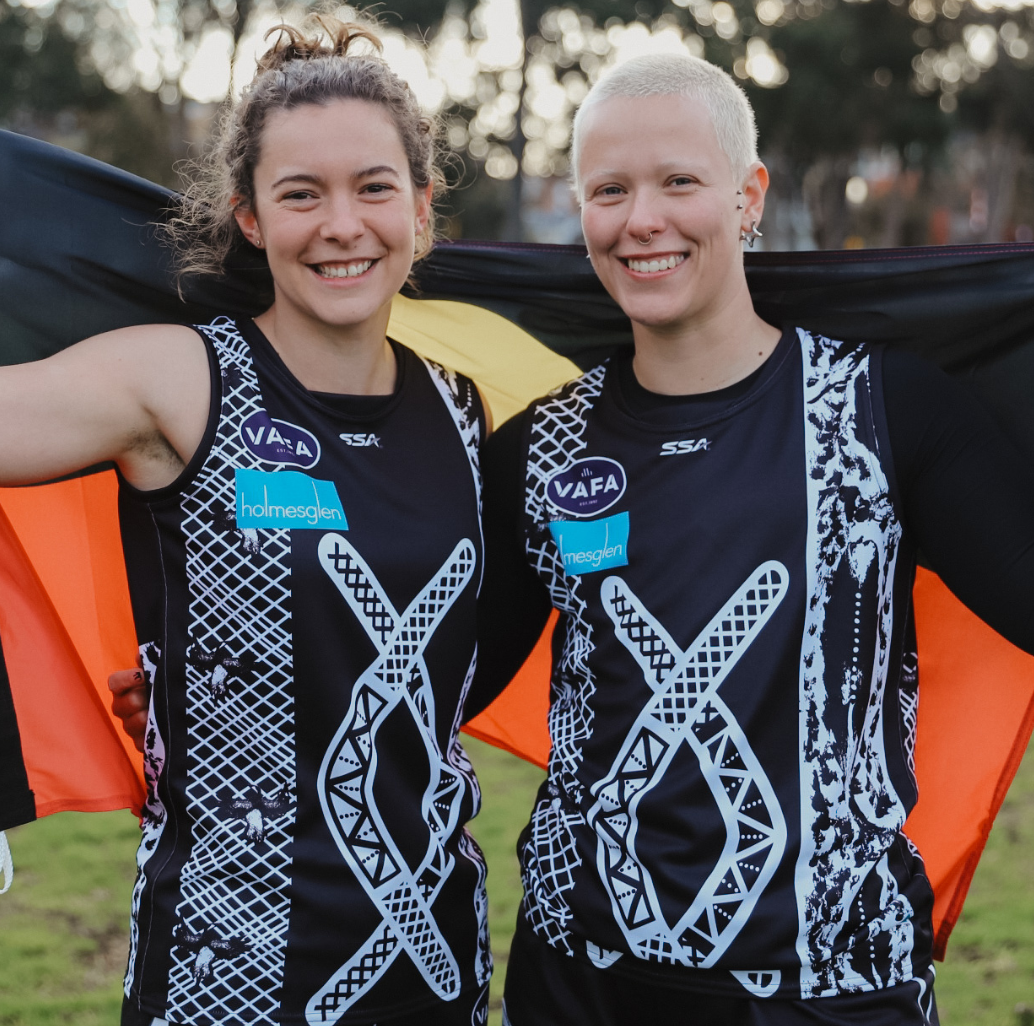
West Brunswick Amateur FC - VAFA
The inaugural WBAFC First Nations guernsey was introduced last year, featuring artwork by past- WBAFC players Steven Hanning (Arrernte and Anmatyerre) and Jethro Calma-Holt, (Kungarakan and Iwaidja). The Guernsey will be worn again this season by all six teams (3 women’s and 3 men’s teams) at our annual First Nations Round, held in NAIDOC Week.
The jumper was presented to the club at our First Nations Round training night by Jethro, who spoke of his family history and talked to our players about the design and the importance of the round. We also heard from current Indigenous players from the club ahead of the round.
The artwork features the following elements as described by the artists -
Clap Sticks: Crosshatching art styles mostly used in the top end/arnhem land and using the sticks for corroboree.
Flying Magpies: The design encourages us all to be our best and respect those around us, with cross hatching style from North East Arnhem Land.
(Note: the Magpie is our club emblem)
Scattered Feathers: Resembles the mark our players leave around the grounds when playing for the Club, with dots painting style from the Central Desert.
Magpie Footprints: Dot painting from central desert with magpie footprints representing mob moving around but the magpie follows.
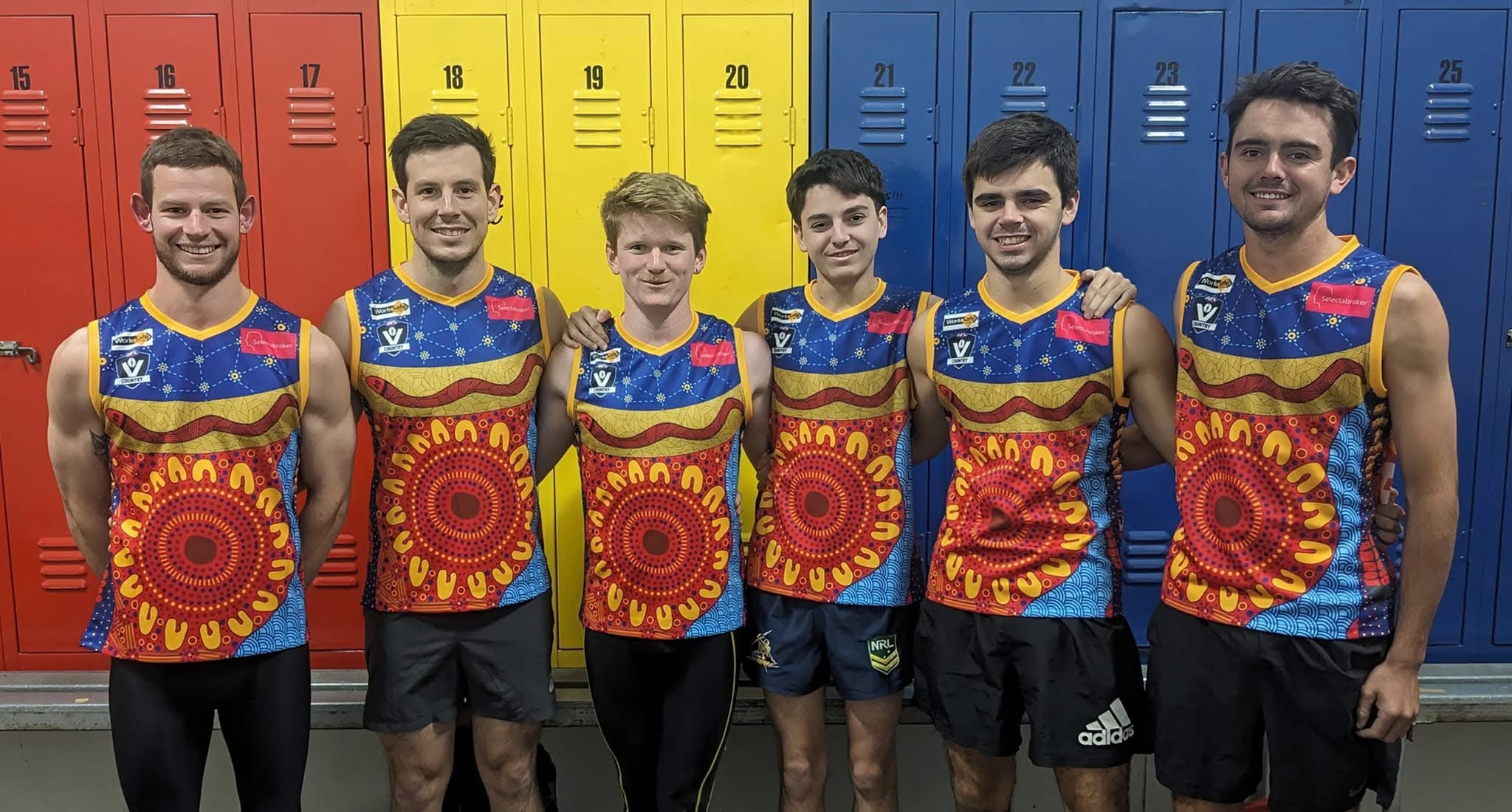
Marong FNC - Loddon Valley FNL
Artists: Stephen Korp Renee McCaig, with her three sons Jack, Noah and Kobe McCaig who are all from Wemba Wamba country
The front represents the night sky and the stars represent the place
The boomerang in the yellow represents community as well as the rainbow serpent
The red bottom meaning meeting place which is the club and people are sitting around like the community
In the capacity river which is connected in the Rhodan Valley football league
The back of the design is the night sky plus the stars again
The boomerang representing a meeting place with handprints for the netball and the footprints for the footballers
The red is the meaning place where all communities come together with the back of the campape river falling from the front
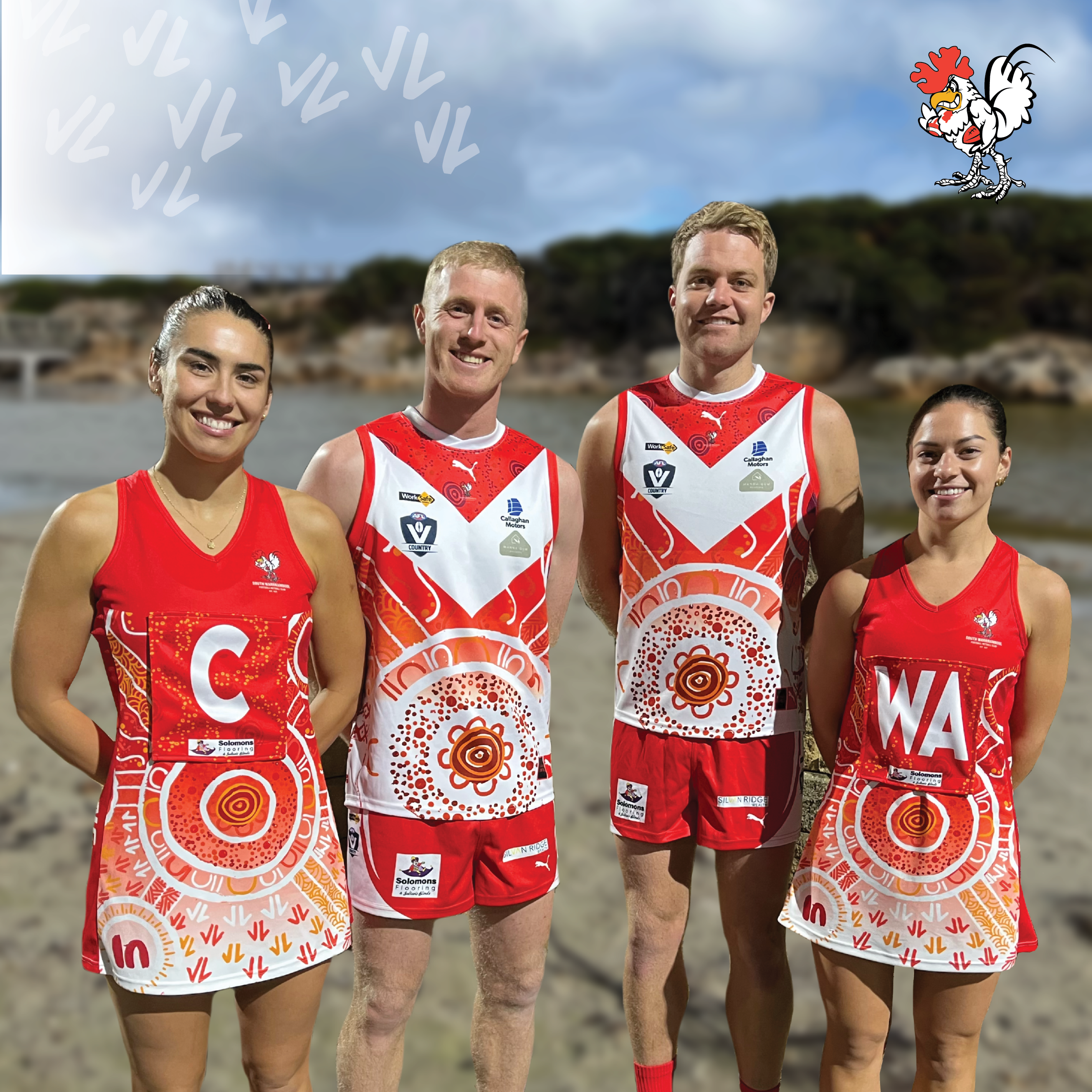
South Warrnambool FNC - Hampden FNL
Artist: Stephanie Thompson (Nee Clarke) from Kirrae Gunditj Art
Her mob is Clarke/Austin mob from Framlingham mission, Purnim and surrounds. She is part of the traditional owners of the Framlingham trust with Eastern Maar group family group 3. Steph states her dad was an amazingly talented Aboriginal artist and taught her to paint traditional and
contemporary ways. Steph paints her works on canvas as a keepsake for the club.
The Story: Country Meets the Sea (as told by the artist)
On the lands of the Gunditjmara, where the rolling plains meet the vast ocean, the stories of past and present intertwine.
At the heart of this place lies a sacred gathering ground—the football and netball club, represented by a central circle. More than just a field, it is a meeting place, where the community comes
together in spirit and competition. It is where cheers ring out, where battles are fought not with weapons but with skill and determination, and where victories are celebrated together, win or lose.
Encircling the club, small circles represent the children, the future of the community. They watch, they learn, they grow—dreaming of the day they will take their place in the teams, their footsteps emerging with those who came before them. They are the beating heart of tomorrow, nurtured by
the strength of today.
Beyond them, forming the outer ring, stand the men and women who play for the South Warrnambool Football Netball Club (SWFNC). Warriors of the game, they embody resilience, teamwork, and pride. They run across the field and court, carrying not only the ball but also the hopes of their people. Their strength is drawn from more than just training—it is drawn from Country, from family, from the stories written in the land beneath their feet.
Flowing from the land towards the sea, squiggly lines ripple like rivers winding through Country, carrying stories to the deep blue, just as the Merri River winds through South Warrnambool and meets the ocean at Stingray Bay and Middle Island.
Dotted patterns dance along these waters, echoing the songlines that have guided generations. Here, the land and sea are not separate but woven together, each dependent on the other, just as the people are connected through culture, sport, and kinship.
Kangaroo footprints scatter across the earth, a reminder of the land’s connection to its people and the native animals that called South Warrnambool home. Their tracks speak of journeys taken long before today—of survival, community, and the unbreakable bond between Country and those who walk upon it.
Together, land and sea, past and future, players and supporters—all are part of the same great story.
This is Country meeting the sea, community meeting strength, and culture standing tall in the face of time.
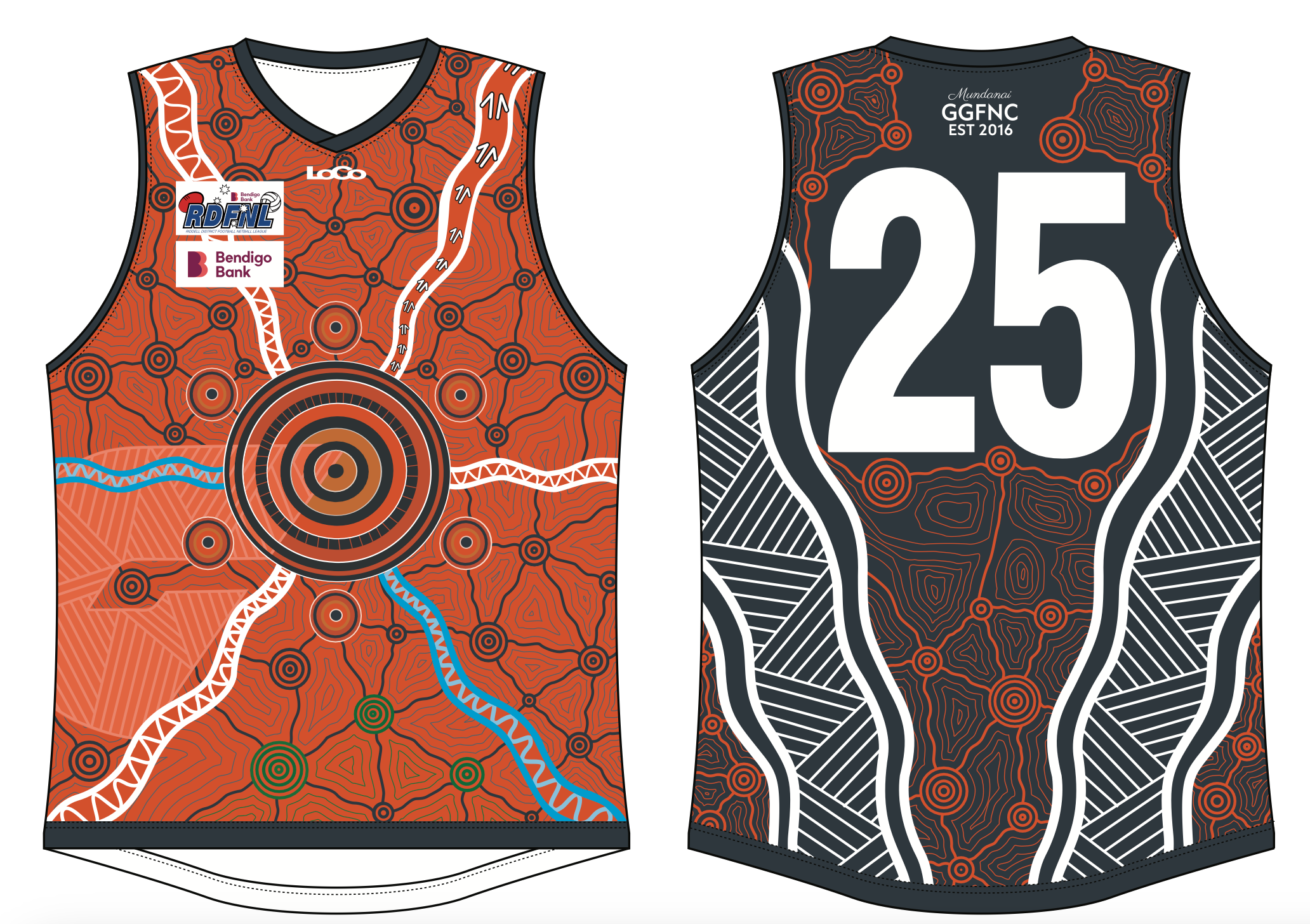
Gisborne Giants FNC - Riddell District FNL
Artist: Ky-ya Nicholson Ward is a 22 year old Wurundjeri, Dja Dja Wurrung, Ngurai illum Wurrung, German and Irish woman.
She is based in Naarm (Melbourne). Ky-ya is a passionate First Nations artist who tells the stories of her ancestors, family and Country. She also uses her art to educate and to advocate political issues around the world. Ky-ya is also an activist, educator, mentor and dancer with Djirri Djirri Cultural Services.
About Ky-ya Design:
CENTRAL MEETING PLACE: This celebrates the community at Gisborne FNC, highlighting unity and being a welcoming space.
Honouring all of the children, parents, volunteers, staff, coaches and supporters that play their part to make the club what it is. Honouring many gatherings since time immemorial.
BACKGROUND MEETING PLACES: This represents the connection between people at the club, highlighting teamwork and
the importance & power of working together. This also symbolises the beautiful landscape of Wurundjeri Country.
GREEN MEETING PLACES: This represents Wurundjeri Country and the bushlands surrounding the club, including the sacred ‘Macedon Ranges’. It honours and respects the history and spirit of sacred Wurundjeri lands. Highlighting that we live, play and learn on traditional country.
WHITE LINEWORK (Front): This symbolises the journey of growth for both the club and the development of kids that play sports at Gisborne FNC.
MARRAM (Kangaroo) FOOTPRINTS: The marram footprints symbolise moving forward towards a positive future, as the marram
can only physically move forward not backwards. This also honours the local animals of Wurundjeri Country.
BLUE LINEWORK: The blue linework symbolises the beautiful waterways that flow throughout Wurundjeri Country. Water is in
every living thing and gives everything life, it’s an important part of country.
CROSSHATCHING: Crosshatching symbolises strength and resilience, as used traditionally on weapons as shields. Highlighting
protecting and caring for one another.
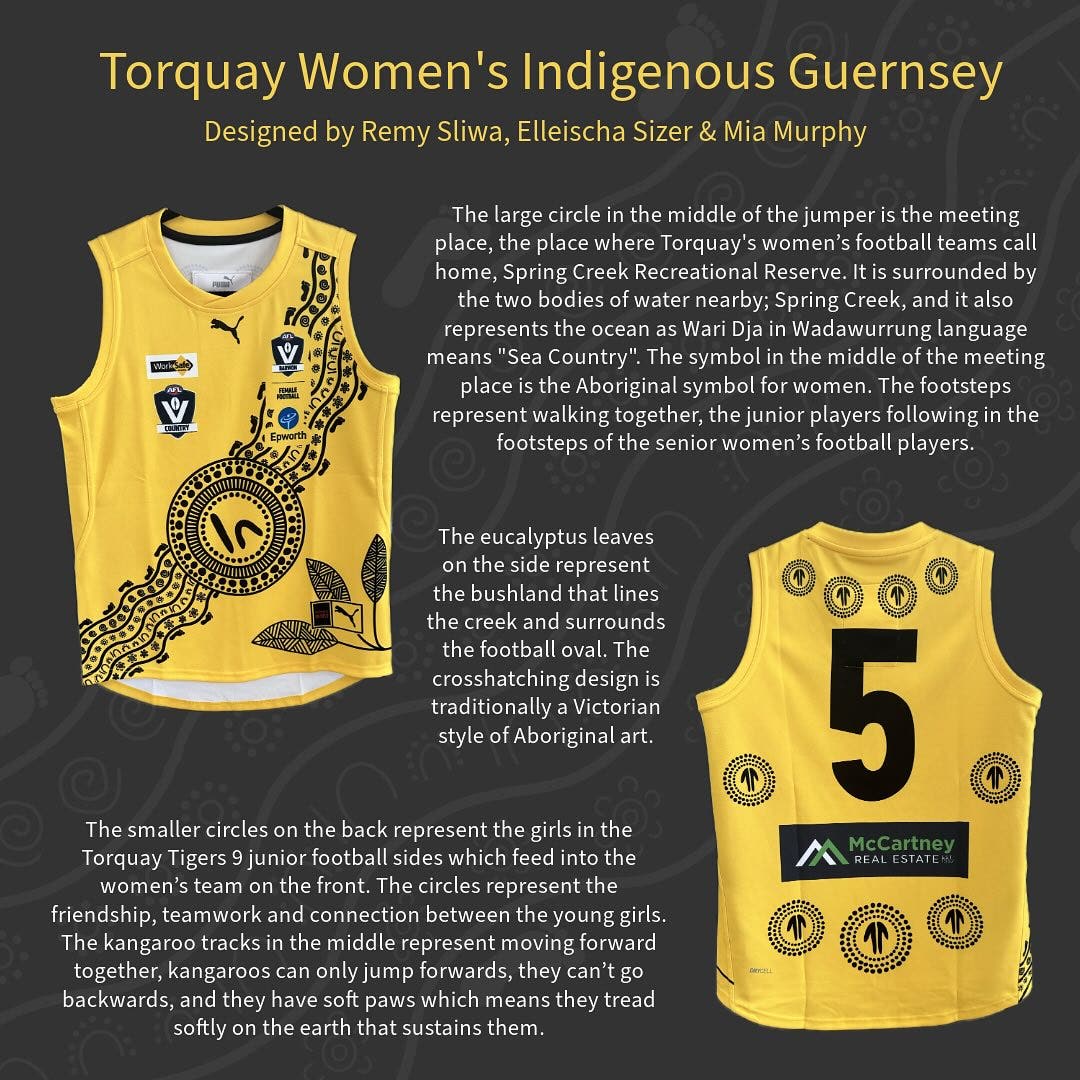
Torquay Tigers FNC - AFL Barwon
Artist: Remy Sliwa, Elleischa Sizer & Mia Murphy
The large circle in the middle of the jumper is the meeting place, the place where Torquay's women's football teams call
home, Spring Creek Recreational Reserve. It is surrounded by the two bodies of water nearby; Spring Creek, and it also represents the ocean as Wari Dja in Wadawurrung language means "Sea Country". The symbol in the middle of the meeting place is the Aboriginal symbol for women. The footsteps represent walking together, the junior players following in the footsteps of the senior women's football players. The eucalyptus leaves on the side represent the bushland that lines the creek and surrounds the football oval. The crosshatching design is traditionally a Victorian style of Aboriginal art.
The smaller circles on the back represent the girls in the Torquay Tigers 9 junior football sides which feed into the women's team on the front. The circles represent the friendship, teamwork and connection between the young girls. The kangaroo tracks in the middle represent moving forward together, kangaroos can only jump forwards, they can't go backwards, and they have soft paws which means they tread softly on the earth that sustains them.
The designers play for the junior Torquay Tigers teams and Elleischa and Remy play in the Geelong Cats NGA program.
All girls very proud to share their culture with the club and the league.
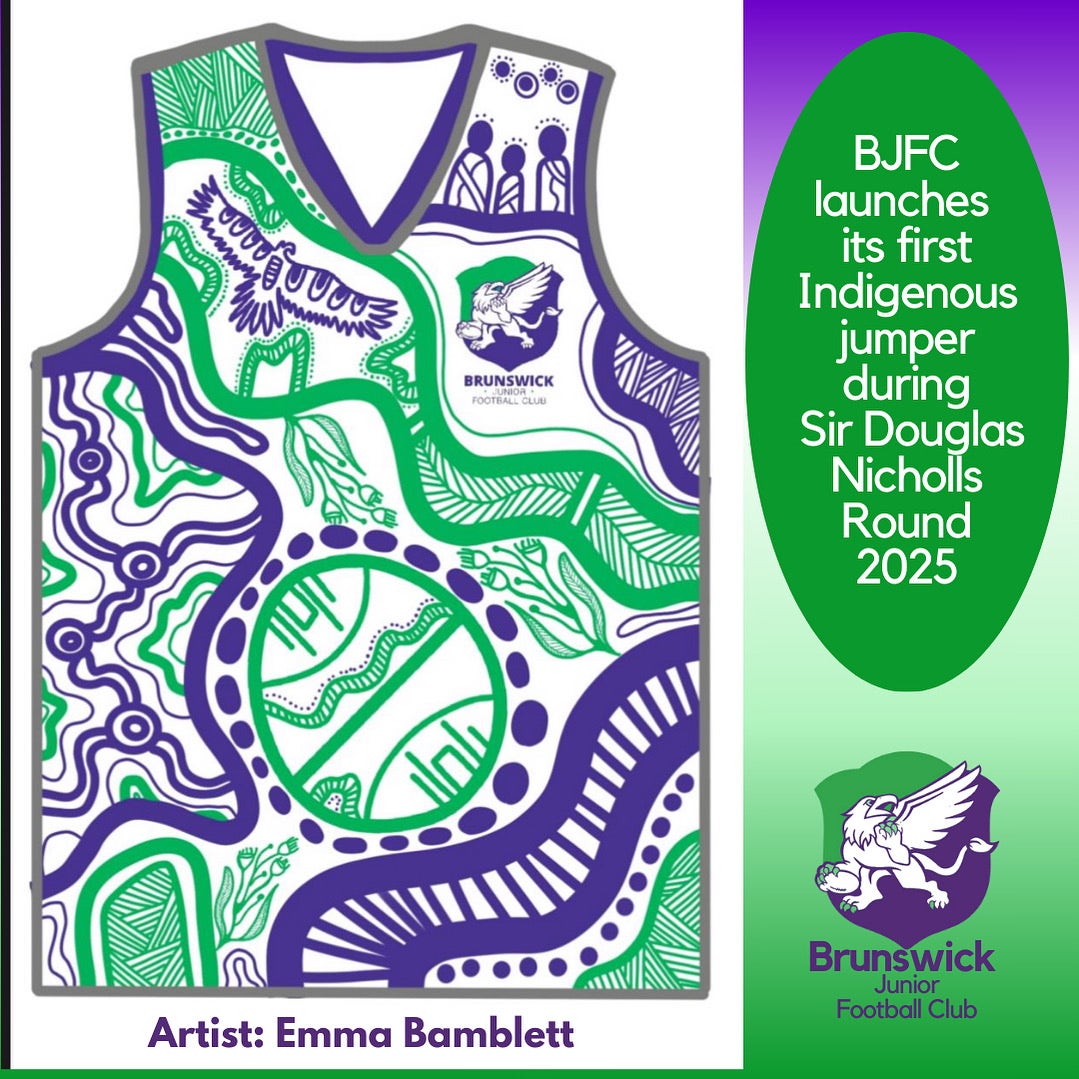
Brunswick JFC - YJFL
Artist: Emma Bamblett
Mobs: Wemba Wemba, Gunditjmara, Ngadjonji and Taungurung
The artwork is created to represent the Brunswick Dragons football club, and their journey to acknowledge
and celebrate Aboriginal Culture and Peoples. Front left side of the jumper is Bunjil the Wedge Tail Eagle, he is soaring across the jumper to care for the people and represent the connection to the Wurundjeri Lands andpeople who are the Custodians of the land on which the grounds is placed.
The left top side of the jumper Elders standing strong on the shoulder of the jumper under the stars. They are giving guidance and sharing their stories of the Land. In the centre of the jumper is the football oval, there is curved lines running across to highlight the players and their connection with the club. Surrounding the oval is large purple circles to highlight all the families and Communities watching. To the left side of the jumper is circles connected with curved lines to show the teamwork of the players on and off the field. They are coming together learning and sharing.
Throughout the artwork there is gum leaves to highlight Aboriginal Culture and ceremony. There is curved lines with continuous lines throughout all over the artwork which represents respect. It is throughout out and in all elements of football and Community. On the back left bottom corner of the jumper is hill formations paying represents to the Wurundjeri peoples and their language is represented through the lines streaming across the back.
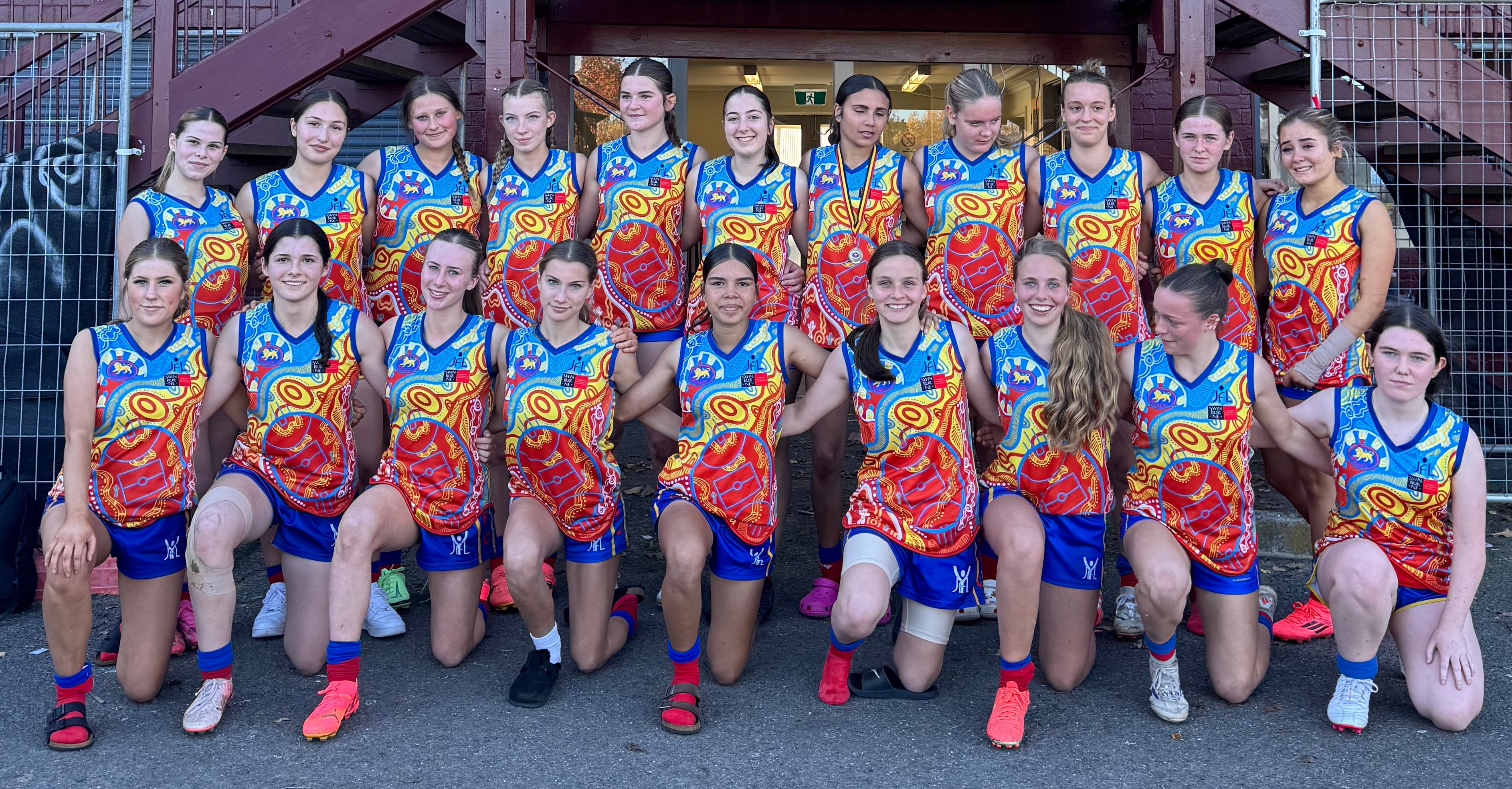
Fitzroy JFC - YJFL
Artist: Emma Bamblett
The Fitzroy Junior Football Club contacted local Aboriginal artist, Emma Bamblett and started conversations around wanting the U15’s to contribute ideas and feelings to be part of the first ever Indigenous jersey design for the club.
Emma had asked the young people to talk about what is important to them at the Fitzroy Junior F.C. Key discussions around themes such as Community, pride, friendship, effort, teamwork, respect, acceptance, equality, spirit were among the ideas and stories of what makes them proud to play and be part of The Fitzroy Junior Football Club. The players talked about their values, beliefs, their eagerness to learn and celebrate Aboriginal history, culture and their vision for the future players to also acknowledge and respect Aboriginal culture.
A key highlight of the artwork is the footy oval on the bottom left corner to represent Brunswick Street Oval (BOS) where the strong history and community feeling comes from. The Aboriginal flag within the middle of the oval represents the respect for Aboriginal people and the influence that they had on the game of football from past and current players.
The yellow line work on the footy oval represents the game and journey that football provides for every player on the field. The figures on the oval represent the young players.
Bunjil the eagle on the top left side of the jersey represents respect for the creator spirit of the Wurundjeri people. The section on the top right side of the jersey with the people sitting around represents teamwork. The gum leaf designs throughout the artwork represent a journey of acceptance and equality. The line work throughout the artwork represents respect and strength.
The section at the bottom of the artwork with the figures standing represents Coaching and Mentoring and the role that these important roles play for young people. The centre stream that flows across the centre of the jersey represents Merri Creek and the important role that the creek played for the lifestyle of Aboriginal people. The white circles connected by the curved lines throughout the artwork represents a sense of Community and the opportunities which the club plays for creating spaces for a place of belonging.
As the AFL world celebrates Indigenous Round, Fitzroy Footy Club recognises our part in Indigenous Footy History.
Fitzroy Football club is known as the club where, in 1904, the first recognised Indigenous player Joe Johnson played VFL football.
On the 7th of May 1904, Joe Johnson became the first known Aborigine to play VFL football and he played for FITZROY. In total Joe played 55 games for Fitzroy and in his debut year he became the first ever Aboriginal player to play in a premiership side. He also played in the 1905 premiership side
In 2011 the Joe Johnson medal was introduced awarding a player from each team for demonstrating in the most outstanding way, the five principles and attributes of Endurance, Tenacity, Courage, Loyalty and Pride.