
As part of our celebration of 100 years of the Phelan Medal, each week we’re spotlighting a past Phelan Medallist and their contribution to AFL Sydney history.
Football Background
Full Name: Anthony (Tony) Whish-Wilson
Nickname: Whishy
Playing Position/s: Centre/o-ball
Playing Status: Retired
Phelan Medal Receipt Year/s: 1960
Years playing in Sydney: 12 games (1 year)
Sydney Senior Club/s: Bankstown
Pocket Profile Questions
Toughest Opponent in Sydney?
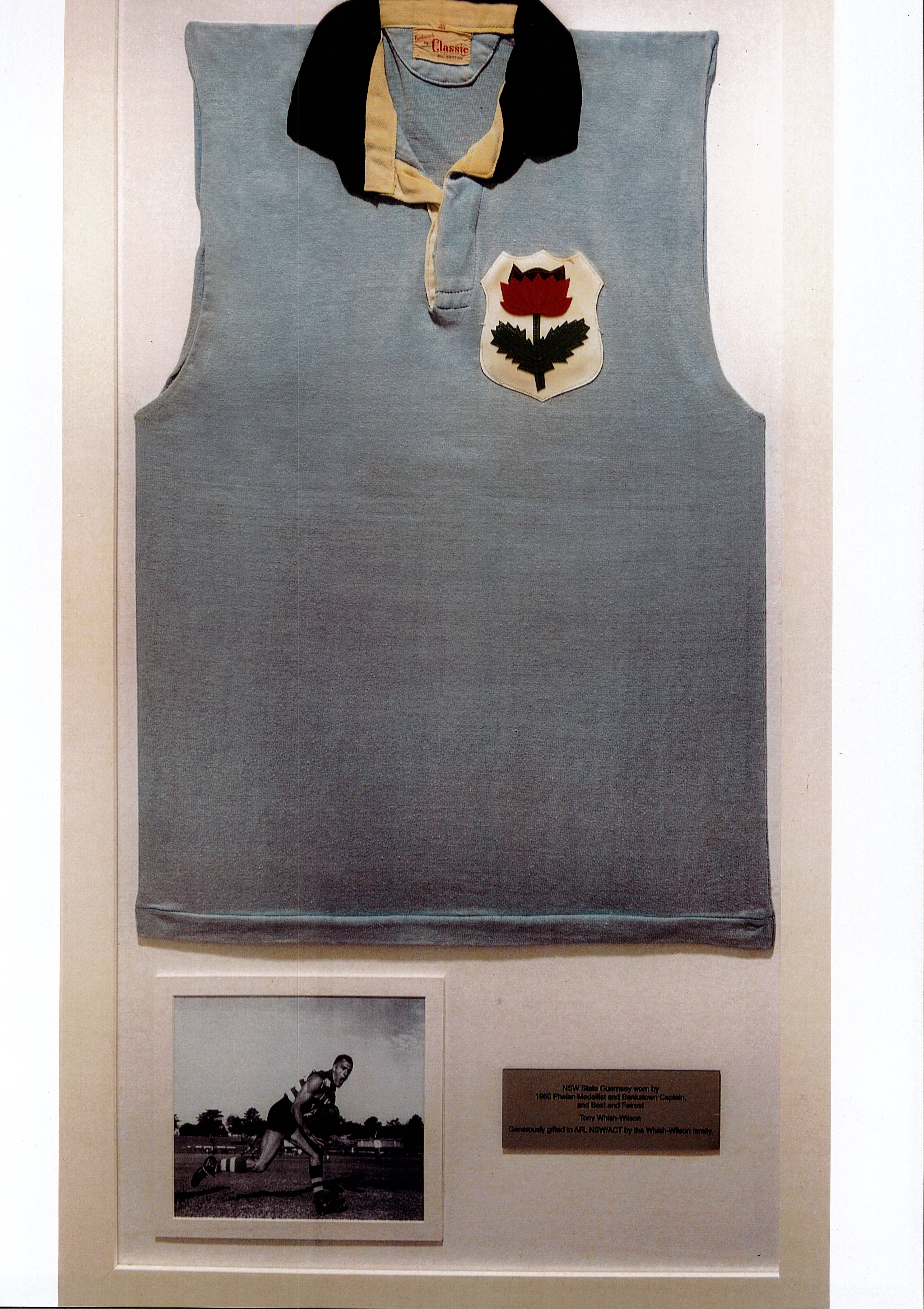
Having played in other competitions prior to my stint with Bankstown in the Sydney League in 1960, I had discovered the toughest opponents were always the most skilled ball-players as opposed to those who relied primarily on physicality. All the Sydney opposition teams fielded players who liked to play the game ‘hard and tough’ but often with a lack of finesse and fairness thus penalising their team and acting as a detriment to the game as a spectacle. No one team or player stands out in this regard. The two photos may not be as clear as desired but one shows me in my Bankstown jumper; and the other is of my State Jumper, etc, I believe framed and now hanging in the AFL/NSW gallery.
What did winning a Phelan Medal/s mean to you?
I played my first game of ‘senior’ football at the age of 15; and by the time I arrived at Bankstown just prior to the 1960 season, I had played in a number of competitions (of varying standards) in three different states, and overseas (Rugby Union). This nomadic existence meant that I was never able to immerse myself fully in a club culture, feel strong allegiance and support its wider community interests. Winning the Phelan means I now have a continuing connection to football in NSW, which I value highly. This has been reinforced by annual invitations to attend medal presentation nights; a memorable event at the SCG for a retrospective presentation of medals (by the great RD Barassi); requests for football memorabilia; and this invitation to contribute a” Pocket Profile”.
It has also provided me with a sense that I have in some way repaid the club that had embraced me fully and made my too- brief time there so enjoyable. The Bankstown B&F medal, together with the Phelan, now occupy pride of place in an otherwise very sparse Medal cabinet.
What impact did winning a Phelan Medal have on your playing career?
On reflection : it has had both a positive and a negative impact. The positive is that it has provided me with a strong, lasting connection to the AFL /NSW football scene. The negative is that it created expectations of me that, realistically, I would not be able to deliver later in a higher-standard League. To explain briefly: after Sydney, I was posted to the RAAF Air Base at Pearce, some 40 km’s north of Perth, in WA. I was surprised soon after arrival to receive approaches from three WAFL clubs ,seeking my signature. In the event, I chose to sign with the previous year’s premier team. More surprising still, this precipitated newspaper stories “RAAF flyer to join Premiers”; “Won every award in NSW” etc. Invitations to appear on TV sporting shows followed. Bemused by all this attention, I was still able to complete a decent pre-season and was selected for the opening game against the previous year’s runners-up: fierce, traditional rivals. As explained to me later by a prominent sports journalist: I took to the ground that day with a prominent “bulls eye” on my back, bound to be targeted by a fired-up opposition. A replay would show a melee starting at the opening bounce, leaving me on the ground, battered, bloodied and dazed.
I only dimly remember playing out the game, and being transported back to the Air Base afterwards where I would have a semi-detached ear stitched back in place, and kept in hospital overnight with a splitting head-ache (concussion?). My CO was not at all pleased as I was supposed to lead the RAAF team in an always fiercely-contested Inter-Service mid-week game that week but this was vetoed by medical staff, the ban lasting for two weeks. Thus my footballing journey had hit a major hurdle as injuries and RAAF commitments meant I was unable to train regularly, nor play. Inevitably, my time in the WAFL would come to a close, by mutual consent, after two interrupted seasons.
I was fortunate to be able to continue playing highly-competitive football at this juncture by taking on the role of Captain/Coach of the RAAF Inter-Service team against Army, Navy and Police teams. These were frequently “knock-down, drag-out” affairs as inter-service sporting rivalry is ‘next level’ competitive. I’m proud to relate that the RAAF won both years that I was involved.
I also at that time ( a part-time University student) accepted an invitation to play for the UWA team so as to be eligible to be play in their pursuit of a first-ever Inter-Varsity win, the competition scheduled to be played in Perth end of 1964. There was great jubilation when the team won its first-ever McLelland Trophy; and I was both surprised, and pleased, to be named in the All-Australian Varsity Team. This ‘award’ rates very highly with me given the number of teams involved, and the very high standard of play.
What is your most memorable moment from your career in Sydney?
Being presented with my first State Jumper.
Did you have any pre-game superstitions or routines?
None
What is the best advice you received as a player and from who?
Some of my earliest child-hood memories of growing up in rural NE Tasmania are of kicking a battered old football around in a cow paddock on our farm, competing with my brothers and friends. At that time, my father was Secretary of our local country football club, and goal umpire. I thus grew up living, and loving football. When I started playing schoolboy football, Dad was my biggest supporter and critic. Some of the advice he offered in those formative years would resonate with me throughout my playing days: learn to kick with both feet and handball with both hands or you will never be a good footballer; and, play the game fairly and always show respect for opponents, and umpires.
What would be one piece of advice for young players coming into AFL Sydney?
Model your game on one of the Sydney Swan players you most admire. Today, I would choose the talented Isaac Heeney.
If retired, what do you miss most about footy?
Nothing really. I'm a keen watcher still; and have memories to last a lifetime.